


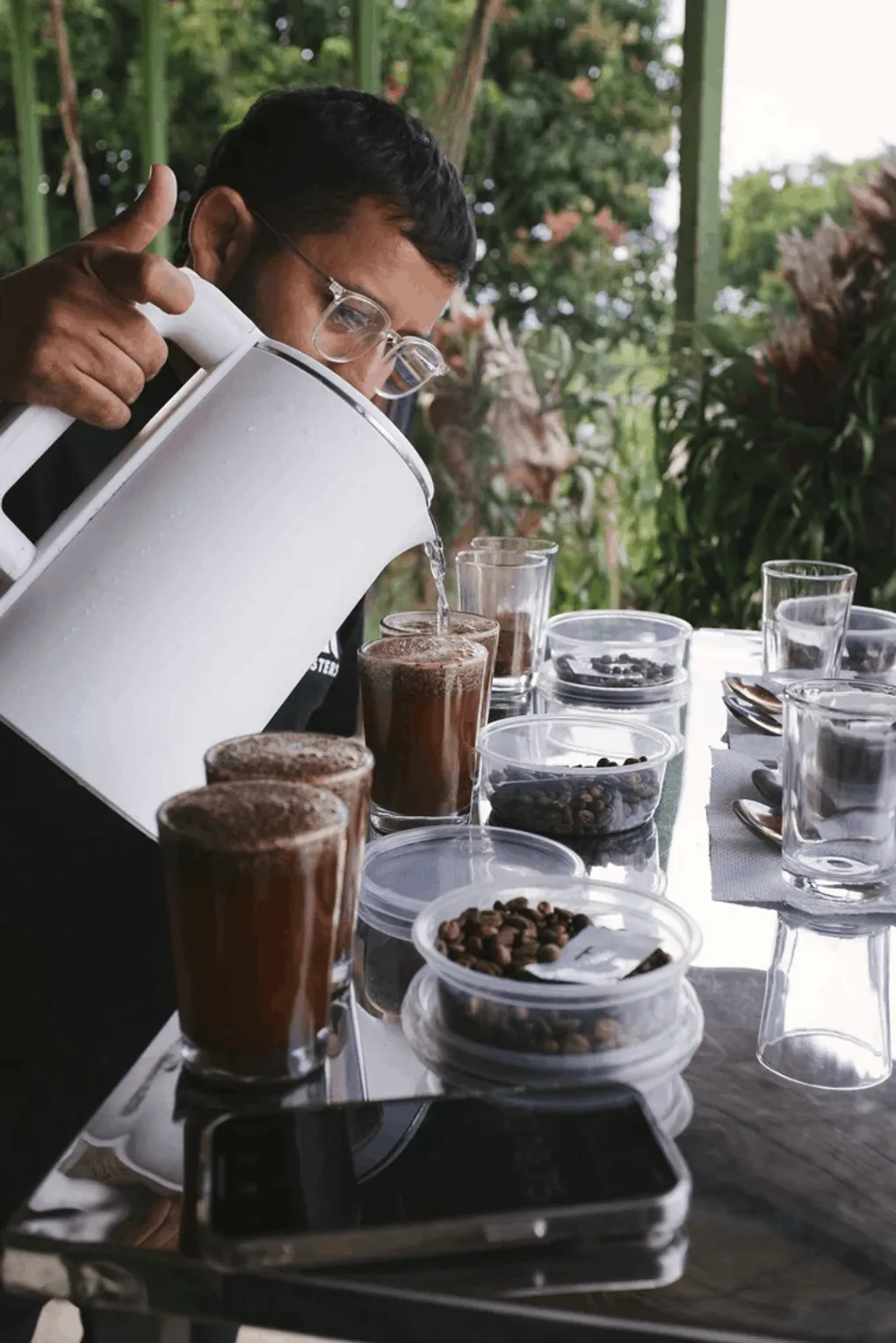
Resident Coffee's Juan Puerta and Mango Osmotic Dehydration
Colombia is the third largest coffee producer in the world - behind only Brazil and Vietnam.
With the rise of specialty and single-origin coffees, Colombia has really taken an interest to higher-priced beans; More and more unique varieties and experimental processing have come out of the country in the past decade. Varieties like Pink Bourbon and Gesha have continued to gain popularity in Colombian micro-lots.
At the same time processing methods (The way the coffee cherry is processed to send to roasters) have become more and more experimental. Co-fermentation, anerobic fermentation, and thermal shocking are just a few methods farmers are using to try and maximize the flavors coming out of their beans - or to add new ones.
Juan Puerta at Finca La Sirena has taken a very unique approach to add more flavor into his coffee - a process that is being called osmotic dehydration.
How does osmotic dehydration work?
We all learned about osmosis in school, but let’s explain it as a refresher; osmosis is the process where water goes through a membrane in order to balance the solution on both sides of the membrane. If you’ve ever soaked a pot of beans, you’ve seen this process in action - the dried beans soak up the water and balance the concentration of solubles.
The exact opposite is happening with these coffee beans - there is a stronger solution outside of the coffee beans than inside of them. That’s how the process of osmotic dehydration works - the coffee beans are put into a “hypertonic glucose solution,” or a solution where there is more glucose outside the bean than inside. In order to balance the solutions, the coffee beans release water and dehydrate themselves.
After the dehydration is done, in the case of Juan Puerta Mango from Resident Coffee, mango is introduced to the mix, and because of the osmotic dehydration, the coffee (in theory) should soak up that mango flavor.
In my opinion, this process does a great job of adding a mango punch to the coffee. It seems less artificial somehow than a lot of coferments, and yields a pleasant mango nectar flavor to the coffee.
As far as I can tell, Juan Puerta at Finca La Sirena is the only producer that is currently using the process of osmotic dehydration. I don’t know how complex it is to perform the process, especially compared to the usual washed or natural process. I don’t think it’s even needed for a large majority of coffees - experimental processes like this are plain ol’ fun, they aren’t made to compete with the complex terroir of a washed single-origin.
At the end of the day, if you enjoy what’s in your cup, then that’s all that matters. There’s no reason to be uptight with what other people do to their coffee - half of the fun is discovering what you like.
Come try out how a mango osmotic dehydration process tastes, while it’s still available. See you at the shop!
-Ivan